Steel TMT (Thermo-Mechanically Treated) bars are the backbone of modern construction. From residential homes to high-rise buildings, bridges, dams, and highways, TMT bars provide the essential tensile strength that reinforced concrete structures require. Understanding the manufacturing process of steel TMT bars is important for builders, engineers, contractors, and even homeowners who want to ensure structural safety and long-term durability.
Table of Contents
This comprehensive guide explains the step-by-step manufacturing process of TMT bars, the science behind their strength, quality control measures, and why modern TMT steel is superior to conventional reinforcement steel.
What Are TMT Bars?
TMT bars are high-strength reinforcement steel bars manufactured using advanced thermo-mechanical treatment technology. The process creates a unique microstructure with:
- A tough outer surface
- A ductile inner core
- High tensile strength
- Excellent weldability
- Superior earthquake resistance
This balance of strength and flexibility makes TMT bars ideal for reinforced cement concrete (RCC) construction.
Complete Manufacturing Process of Steel TMT Bars
The manufacturing of TMT bars involves several carefully controlled stages. Each stage contributes to the final strength, ductility, and durability of the product.
1. Raw Material Selection
The process begins with the selection of high-quality raw materials, typically:
- Iron ore
- Scrap steel
- Sponge iron
- Alloys (if required)
The quality of raw materials directly affects the chemical composition and mechanical properties of the final TMT bar.
Low impurities such as sulfur and phosphorus are essential to ensure better weldability and reduced brittleness.
2. Steel Making Process
The selected raw materials are melted in:
- Electric Arc Furnace (EAF)
- Basic Oxygen Furnace (BOF)
- Induction Furnace
During this stage:
- The metal is heated at extremely high temperatures (around 1600°C).
- Impurities are removed.
- Desired chemical composition is achieved.
Precise control of carbon content is critical. Lower carbon levels improve ductility and weldability.
3. Billet Casting
After melting and refining, the molten steel is cast into semi-finished forms called billets through a process known as continuous casting.
Billets are solid rectangular steel sections that serve as the base material for rolling TMT bars.
Quality checks during this stage ensure:
- Uniform chemical composition
- No internal cracks
- No structural defects
4. Reheating of Billets
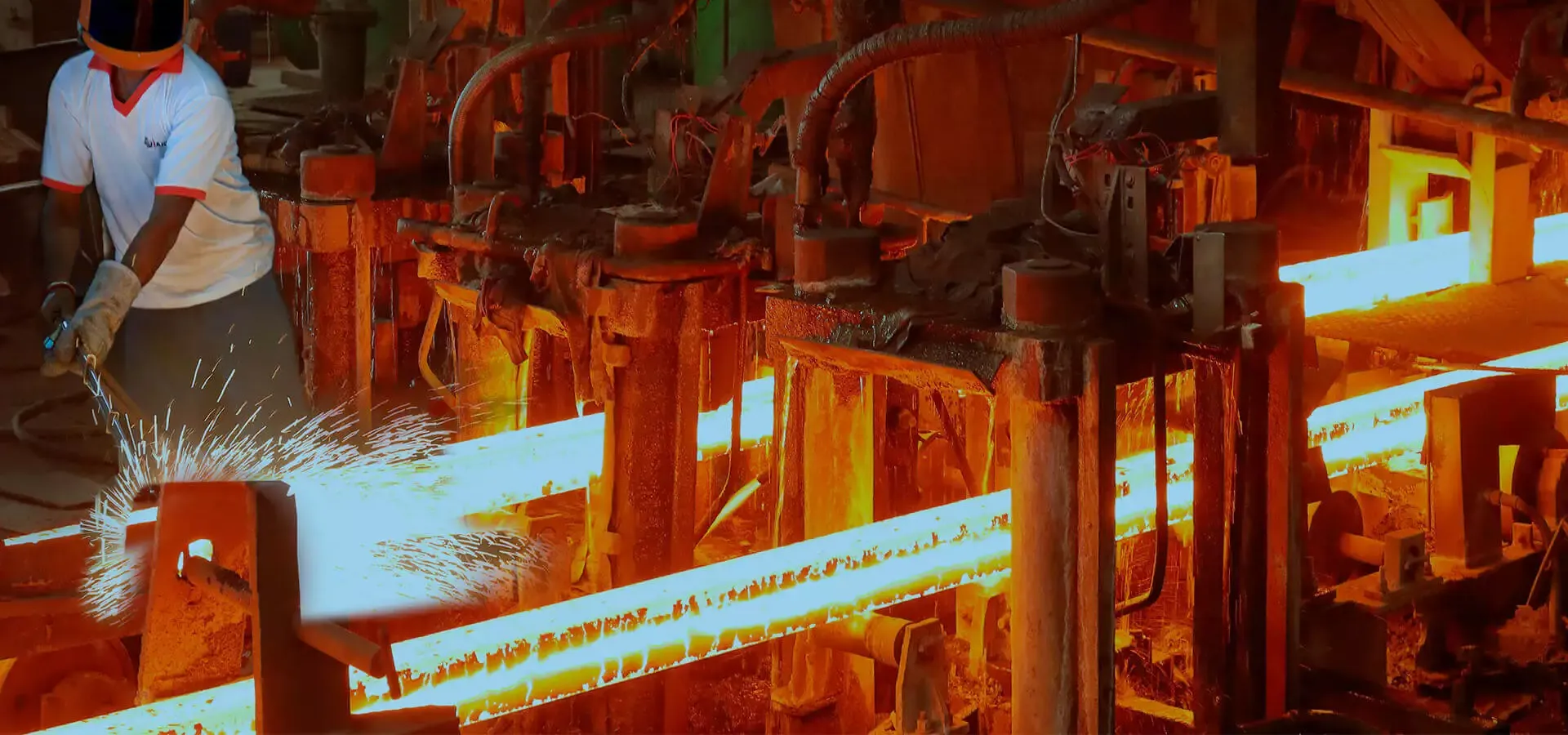
The steel billets are transferred to a reheating furnace where they are heated to approximately 1100–1200°C.
Proper reheating ensures:
- Uniform temperature distribution
- Proper plastic deformation during rolling
- Improved metallurgical properties
Uneven heating can result in structural inconsistencies.
5. Rolling Process
After reheating, billets pass through a series of rolling mills.
This stage shapes the billets into long steel bars of required diameters (such as 8mm, 10mm, 12mm, 16mm, etc.).
Key Steps in Rolling:
- Roughing mill reduces billet size
- Intermediate rolling shapes the bar
- Finishing mill gives final diameter and rib pattern
The rib pattern is formed during this stage to ensure strong bonding with concrete.
6. Thermo-Mechanical Treatment (TMT Process)
This is the most critical stage in TMT bar manufacturing.
Immediately after the final rolling stage, the hot steel bars undergo rapid water quenching in a special chamber called the quenching box.
What Happens During Quenching?
- The outer surface cools rapidly and hardens.
- The core remains hot and soft.
- A temperature difference is created between the surface and core.
This creates a hard outer martensitic layer while the core remains ductile.
7. Self-Tempering Process
After quenching, the bars are allowed to cool naturally on a cooling bed.
The heat from the inner core flows outward, tempering the outer hardened layer.
This process:
- Relieves internal stress
- Enhances ductility
- Improves toughness
The final result is a TMT bar with:
- Hard exterior
- Soft, flexible interior
This structure gives TMT bars high strength with excellent flexibility.
8. Cooling and Cutting
The bars are cooled under atmospheric conditions and then cut into standard lengths (usually 12 meters).
During this stage:
- Bars are straightened
- Surface quality is checked
- Dimensions are verified
9. Quality Testing and Inspection
Before dispatch, TMT bars undergo multiple quality tests:
Mechanical Tests
- Tensile strength test
- Yield strength test
- Elongation test
- Bend and re-bend test
Chemical Tests
- Carbon content
- Sulfur and phosphorus limits
- Alloy verification
Dimensional Checks
- Diameter accuracy
- Weight per meter
- Rib pattern consistency
Only bars that pass IS 1786 standards are approved for supply.
Microstructure of TMT Bars
The strength of TMT bars lies in their unique three-layer structure:
| Layer | Property | Benefit |
|---|---|---|
| Outer Layer | Martensitic | High strength |
| Middle Layer | Bainitic | Toughness |
| Core | Ferrite-Pearlite | Ductility |
This combination provides:
- Earthquake resistance
- Shock absorption
- Load-bearing capacity
Advantages of the TMT Manufacturing Process
The thermo-mechanical treatment process offers several benefits over traditional steel bars:
- Higher strength-to-weight ratio
- Better weldability
- Improved corrosion resistance
- Fire resistance up to 600°C
- Reduced construction cost due to lighter steel usage
Grades of TMT Bars
TMT bars are manufactured in different grades based on yield strength:
| Grade | Yield Strength | Application |
|---|---|---|
| Fe 415 | 415 MPa | Small constructions |
| Fe 500 | 500 MPa | Residential buildings |
| Fe 500D | 500 MPa (High ductility) | Earthquake zones |
| Fe 550D | 550 MPa | High-rise & infrastructure |
Importance of Controlled Manufacturing
Improper quenching or incorrect chemical composition can lead to:
- Brittleness
- Surface cracks
- Reduced ductility
- Poor corrosion resistance
Therefore, selecting TMT bars from reputed manufacturers and authorised dealers is essential.
Frequently Asked Questions (FAQs)
What makes TMT bars stronger than normal steel bars?
The thermo-mechanical treatment process creates a hardened outer layer and ductile core, giving TMT bars superior strength and flexibility compared to ordinary steel.
Why is quenching important in TMT manufacturing?
Quenching rapidly cools the outer surface, forming a hard martensitic layer that improves tensile strength.
What is the role of carbon in TMT bars?
Carbon increases strength, but excessive carbon reduces ductility. Balanced carbon content ensures strength with flexibility.
Are TMT bars corrosion resistant?
Yes. Controlled chemical composition and uniform microstructure improve corrosion resistance, especially in humid regions.
How does TMT manufacturing improve earthquake resistance?
The ductile core allows bars to bend under stress without breaking, absorbing seismic energy.
What is the difference between Fe 500 and Fe 500D?
Fe 500D has higher ductility compared to standard Fe 500, making it more suitable for earthquake-prone areas.
Why is rib pattern important?
Ribs improve bonding between concrete and steel, preventing slippage.
Can TMT bars withstand fire?
Yes. High-quality TMT bars retain strength up to approximately 600°C.
How long do TMT bars last?
With proper construction and maintenance, TMT bars can last several decades without significant strength loss.
Why should I buy TMT bars from authorised dealers?
Authorised dealers ensure genuine products, certified quality, and reliable supply.
Conclusion
The manufacturing process of steel TMT bars is a highly controlled and scientifically engineered procedure designed to produce reinforcement steel with exceptional strength, ductility, and durability. From raw material selection and billet casting to rolling, quenching, and self-tempering, each stage contributes to the superior properties of modern TMT bars.
The thermo-mechanical treatment process is what differentiates TMT bars from traditional reinforcement steel. The hardened outer surface provides high tensile strength, while the ductile core ensures flexibility and earthquake resistance. This combination makes TMT bars the most reliable choice for reinforced concrete structures in residential, commercial, and infrastructure projects.
Understanding the manufacturing process helps builders and homeowners appreciate why quality and certification matter. Always choose ISI-certified TMT bars from trusted suppliers to ensure long-term structural safety.
Strong steel is not just manufactured — it is engineered with precision. And that engineering strength is what builds safe homes, durable buildings, and the future of modern infrastructure.