TMT (Thermo-Mechanically Treated) bars form the structural backbone of reinforced concrete construction. The safety, durability, and strength of any building depend heavily on the quality of TMT bars used. Even the best construction design can fail if the steel reinforcement does not meet required standards.
To ensure reliability, TMT bars undergo several quality testing methods before and during use. This detailed guide explains the most important TMT bars quality testing methods, their purpose, and why they are critical for safe construction.
At Pahari Home Solutions Pvt. Ltd., we supply only certified and tested TMT bars from reputed manufacturers, ensuring peace of mind for builders, contractors, and homeowners across West Bengal.
Table of Contents
Why Quality Testing of TMT Bars Is Important
Quality testing ensures that TMT bars:
- Meet IS 1786 standards
- Possess adequate strength and ductility
- Perform well under load and stress
- Resist corrosion and environmental damage
- Provide long-term structural safety
Without proper testing, low-grade or substandard steel can lead to cracks, deformation, corrosion, and even structural failure.
Types of TMT Bars Quality Testing Methods
1. Tensile Strength Test
The tensile strength test measures how much stress a TMT bar can withstand before breaking. It evaluates:
- Yield strength
- Ultimate tensile strength
- Elongation percentage
High tensile strength ensures that the steel can bear heavy loads without failure.
| Parameter | Importance |
|---|---|
| Yield Strength | Determines load-carrying capacity |
| Ultimate Strength | Indicates maximum stress tolerance |
| Elongation | Measures ductility and flexibility |
This test is conducted using a Universal Testing Machine (UTM).
2. Bend Test
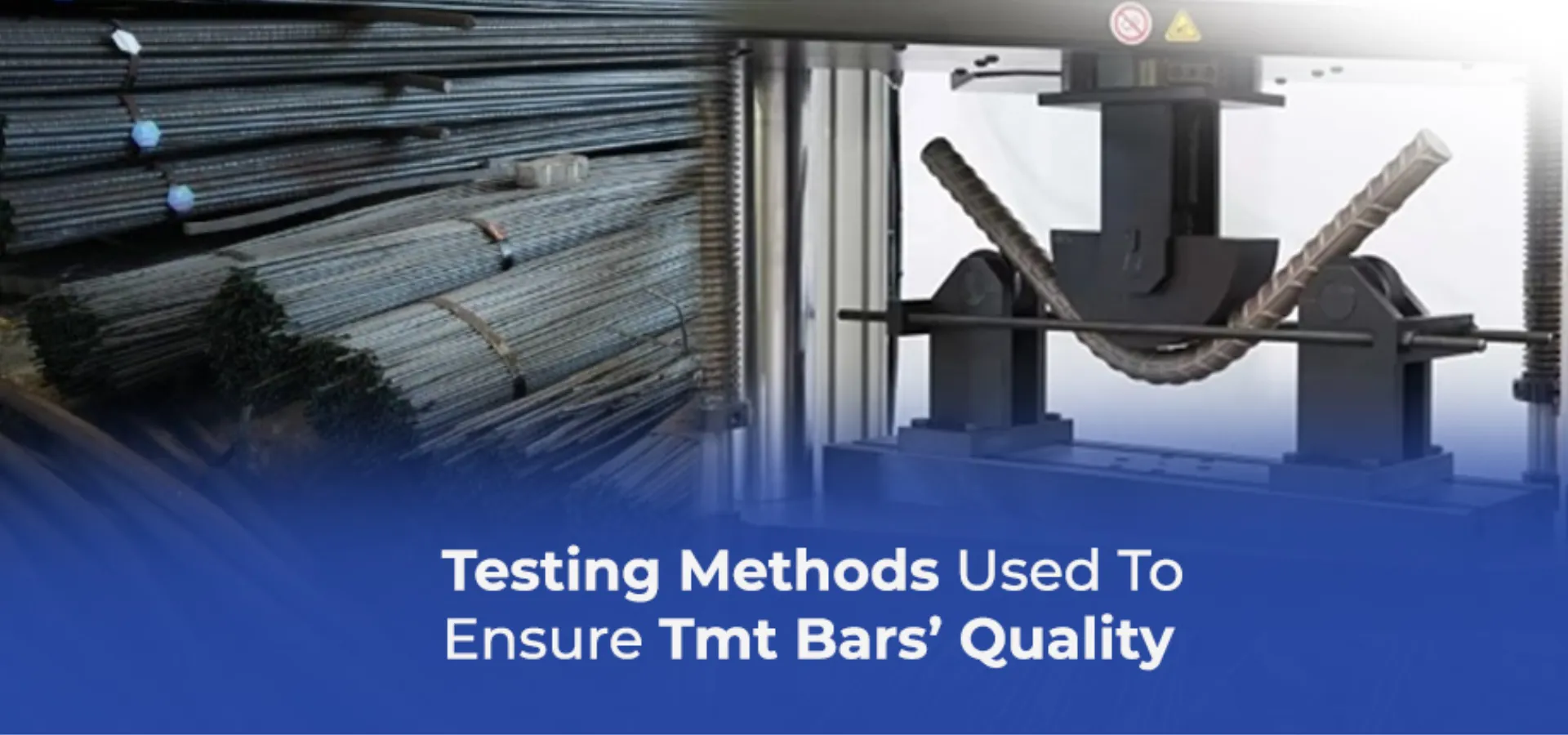
The bend test checks the ductility and flexibility of TMT bars. In this test, the bar is bent to a specified angle (usually 180°) around a mandrel without cracking.
This ensures that the bar can withstand bending during earthquakes and dynamic loads without breaking.
3. Re-Bend Test
The re-bend test evaluates the bar’s resistance to thermal stress. The bar is first bent, then heated to a specific temperature, cooled, and bent again.
This test confirms the ability of TMT bars to maintain strength after thermal exposure, making it essential for fire resistance and durability.
4. Chemical Composition Test
This test checks the chemical elements present in the steel, such as:
- Carbon
- Sulphur
- Phosphorus
- Manganese
Low carbon content improves weldability and ductility, while controlled sulphur and phosphorus levels enhance corrosion resistance.
| Element | Effect on TMT Bar |
|---|---|
| Carbon | Strength & Weldability |
| Sulphur | Affects Brittleness |
| Phosphorus | Impacts Corrosion Resistance |
5. Weight and Dimension Test
This test ensures that the TMT bars match the standard weight and diameter specified by IS norms. Underweight bars indicate inferior quality and reduced strength.
Correct dimensions ensure uniform load distribution and accurate reinforcement calculations.
6. Rib Pattern and Surface Inspection
Visual inspection checks:
- Uniform rib pattern
- Clear brand embossing
- Absence of surface cracks or defects
A proper rib pattern improves bonding between concrete and steel, which is essential for structural integrity.
7. Elongation Test
The elongation test measures how much a TMT bar stretches before breaking. Higher elongation indicates better ductility, which is crucial for earthquake-resistant construction.
Ductile bars absorb energy during seismic activity instead of failing suddenly.
8. Corrosion Resistance Test
This test evaluates how well TMT bars resist rust and corrosion, especially in humid or coastal environments.
Corrosion-resistant bars increase structural life and reduce maintenance costs.
9. Fire Resistance Test
TMT bars are tested for their ability to withstand high temperatures. Quality TMT bars retain strength up to 600°C, making them safer during fire incidents.
10. Weldability Test
Weldability testing ensures that TMT bars can be welded without cracking or loss of strength. This is important for modern construction techniques and fabrication work.
Low carbon and controlled chemical composition improve weldability.
IS Standards for TMT Bars Testing
In India, TMT bars must comply with IS 1786 standards. These standards define:
- Mechanical properties
- Chemical composition limits
- Testing procedures
- Quality benchmarks
Only ISI-certified TMT bars should be used for structural construction.
How Buyers Can Check TMT Bar Quality on Site
- Verify ISI marking and brand embossing
- Check uniform rib patterns
- Measure diameter and weight
- Purchase from authorised dealers
- Request test certificates if needed
Avoid using unbranded or uncertified steel, even if it appears cheaper.
Why Buy Tested TMT Bars from Pahari Home Solutions Pvt. Ltd.
Pahari Home Solutions Pvt. Ltd. is a trusted supplier of certified TMT bars in West Bengal. We deal only in genuine, ISI-certified products from reputed manufacturers.
Our Advantages
- Authorised dealer and distributor
- Quality-tested and certified TMT bars
- Expert guidance for steel selection
- Bulk supply and site delivery support
- Transparent pricing and reliable service
Contact us for Quality TMT Bars
📍 Delivery across Purba Medinipur, Paschim Medinipur, Jhargram, Kolkata, Howrah, and other areas of West Bengal
📞 Phone: +91 7584055356
📧 Email: official@paharihomesolutions.in
🌐 Website: https://paharihomesolutions.in

Conclusion
Quality testing of TMT bars is not just a technical requirement—it is a safety necessity. From tensile strength and ductility to chemical composition and corrosion resistance, each test plays a vital role in ensuring that reinforcement steel performs reliably throughout the building’s lifespan.
Using tested and certified TMT bars reduces construction risks, improves durability, and ensures compliance with engineering standards. By sourcing your TMT bars from a trusted supplier like Pahari Home Solutions Pvt. Ltd., you invest in strength, safety, and long-term peace of mind.
Strong steel builds strong structures—and strong structures secure the future.